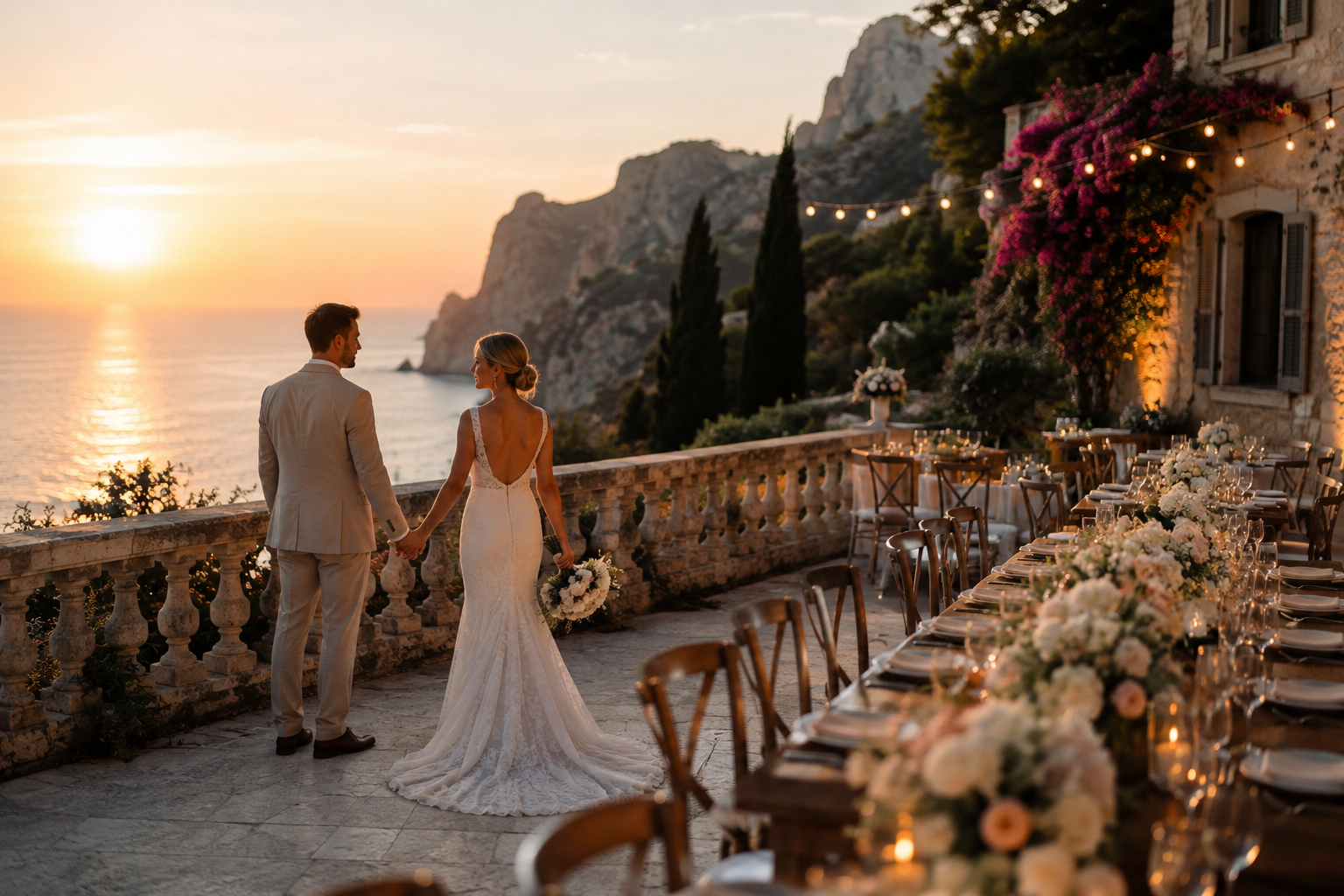
There is an obvious reason Mallorca keeps appearing on destination-wedding shortlists: the island gives you very different versions of the Mediterranean without forcing your guests to spend half the wedding travelling between them. You can get ready in a stone finca, marry with the Tramuntana mountains behind you, have cocktails overlooking the sea and still end the night dancing under the same roof.
But getting married in Mallorca involves more than choosing a beautiful venue and booking flights. Foreign couples quickly run into questions about legal ceremonies, symbolic weddings, seasons, guest transport, budgets, timelines, photography, weather and the simple question of how much you should try to fit into one weekend.
At Revvind, we see Mallorca weddings from the practical side as well as the visual one. A location can look extraordinary in a venue brochure yet become difficult at 3:00 PM in July. A perfectly reasonable timeline can leave no room for sunset portraits. A remote finca can be wonderful for 60 guests but frustrating if nobody has organised transport home.
This guide brings those pieces together. If you're planning a Mallorca destination wedding from abroad, start here.
Why Choose Mallorca for a Destination Wedding?
Mallorca works particularly well when a couple wants a destination wedding that feels like a trip for their guests rather than a single event.
Within one island, you can build a celebration around:
- Mediterranean beaches and secluded coves;
- Tramuntana mountain scenery;
- historic churches and old villages;
- private fincas surrounded by olive trees;
- luxury coastal hotels;
- modern venues around Palma;
- private villas for smaller celebrations;
- marinas, yachts and seaside restaurants for pre- or post-wedding events.
The real advantage is variety. A formal church ceremony, relaxed finca dinner and seaside day-after gathering can belong to the same wedding weekend without feeling visually repetitive.
For photography and film, that variety matters. A Mallorca wedding photographer can tell the story of the island as part of the story of the wedding rather than treating Mallorca as a generic sunny background.
Legal vs Symbolic Wedding in Mallorca: Understand This First
This is the part couples should investigate before paying non-refundable deposits.
Spain does allow marriages involving foreign nationals, and Spanish government guidance states that when both parties are foreigners, a marriage in Spain may be celebrated according to the form prescribed for Spanish marriages or according to the personal law of either party. A marriage also requires prior processing of the relevant marriage file or notarial act to establish that there is no legal impediment.
That does not mean every foreign couple can simply arrive in Mallorca a few days before the wedding and complete all legal formalities locally.
The exact procedure can depend on factors including nationality, residence, previous marital status, the authority dealing with the marriage file and the documents issued in your home country. Foreign documents may also require legalisation or an apostille and, where applicable, an official Spanish translation.
For example, Palma's municipal procedure requires the necessary marriage authorisation before the municipal civil ceremony is arranged.
The practical solution for many destination couples
A very common destination-wedding structure is:
Legal marriage at home + symbolic ceremony in Mallorca.
You complete the legally binding civil ceremony in your country of residence and then hold the wedding you actually imagine in Mallorca: vows, rings, celebrant, music, processional, readings and everything else.
From the guest's perspective, it still feels completely like the wedding. The difference is that you are not asking your wedding weekend to carry complicated international paperwork as well.
When a legal Mallorca ceremony may make sense
Investigate the legal route if:
- one or both of you live in Spain;
- one of you is Spanish;
- your circumstances make the Spanish procedure straightforward;
- having the legal ceremony in Spain is personally important to you;
- you have enough time to handle the administrative process properly.
Because marriage law is not an area where a photographer or wedding planner should replace legal advice, confirm the current requirements with the relevant Spanish Civil Registry, municipality, consulate and, where necessary, a Spanish lawyer before relying on any wedding-blog checklist.
Revvind tip: settle the legal-versus-symbolic question first. Everything else about Mallorca wedding planning becomes easier once you know what kind of ceremony you are actually organising.
When Is the Best Time to Get Married in Mallorca?
There isn't one universally perfect month.
AEMET, Spain's official meteorological agency, publishes climatological normals and historical climate data for the Balearic Islands, and it is worth using official climate information rather than assuming that “Mallorca is sunny all year.”
From a wedding and photography perspective, however, we usually think about Mallorca in four very different ways.
Spring: March to May
Spring works beautifully for couples who want greener landscapes, comfortable outdoor conditions and a quieter island than in peak summer.
April and May are particularly attractive for fincas, village weddings and countryside portraits. You also avoid the most intense summer sun, which gives you more flexibility with ceremony timing.
Potential trade-off: spring weather deserves a genuine backup plan rather than blind optimism.
Best for: fincas, garden ceremonies, Deià and Valldemossa, longer outdoor celebrations.
Summer: June to August
Summer gives you the Mallorca people imagine when they book the island: bright sea, dry landscapes, long evenings and very late sunsets.
It also demands the most careful timeline.
A 3:00 PM outdoor ceremony can look romantic on paper but feel very different when guests are sitting under intense Mediterranean sun. We normally prefer to move the most important outdoor photography later in the day and protect the middle of the afternoon with shade, interiors, lunch or downtime.
July and August also mean peak tourism, so transport, parking and privacy need more attention.
Best for: beach clubs, coastal venues, late ceremonies, pool weekends and couples who want unmistakable Mediterranean summer energy.
Autumn: September to October
For many destination weddings, September is a particularly appealing compromise: the island still feels like summer, while the wedding day can be easier to structure than at the height of July.
October can be gorgeous too, especially for fincas and mountain locations, though weather flexibility becomes increasingly important.
From behind the camera, early autumn gives us excellent opportunities to combine warm landscapes, softer light and comfortable portrait sessions.
Best for: destination weddings, fincas, sunset celebrations and couples who want the summer feeling without building the entire day around extreme heat.
Winter: November to February
Mallorca in winter is quieter and more atmospheric. This is not the obvious choice for a beach-style destination wedding, but it can work beautifully for small celebrations, churches, Palma weddings and intimate finca gatherings.
The most important difference is daylight: your schedule needs to be built around an earlier sunset.
Best for: intimate weddings, city celebrations, churches and couples who value atmosphere over beach weather.
Choosing the Right Mallorca Wedding Venue
Don't choose a venue from photographs alone.
When we look at a venue, we ask questions that are slightly different from the usual capacity-and-menu checklist.
Think about the ceremony orientation
Where will the sun actually be?
A sea-view ceremony may be stunning at sunset and punishing several hours earlier. One partner may be in direct sun while the other stands in shade. Guests may spend the ceremony squinting toward the light.
Visit at approximately the same time of day as your planned ceremony when possible.
Look for portrait variety
Ideally, we should not need to put you in a car for an hour simply to create different-looking wedding portraits.
Strong venues often offer several of these within walking distance:
- open landscape;
- shaded stone walls;
- gardens or olive trees;
- architecture;
- terraces;
- sea or mountain views;
- an indoor option.
That lets us photograph for ten minutes, return you to your guests and come back out again when the light becomes exceptional.
Check the rain and wind backup
A “backup” is not simply a room where everybody technically fits.
Ask yourself whether you would still enjoy the wedding if the backup plan became the real plan.
This matters particularly for outdoor destination wedding Mallorca Spain celebrations where most of the visual concept has been built around terraces or gardens.
Think about the scale
Forty guests in a beautiful space designed for forty can feel extraordinary.
Forty guests scattered around a venue built for three hundred can feel strangely empty.
For intimate weddings, smaller fincas, villas and private terraces often create much more emotional energy than choosing the largest venue the budget permits.
What Type of Venue Fits Your Wedding?
A finca
Choose a finca if you want privacy, natural texture, stone, olive trees and a relaxed transition from ceremony to dinner.
Fincas are particularly good for destination weddings because your guests can settle into the environment rather than constantly changing locations.
A coastal venue
Choose the coast if the sea is central to why you're getting married in Mallorca.
The reward is obvious: enormous horizons, sunset light and a genuine sense of place. The trade-offs are wind, stronger light and potentially more complicated access.
A private villa
A villa works brilliantly for smaller weddings and couples who want flexibility.
Getting ready, ceremony, cocktails and dinner can all happen without transport, and you gain privacy for portraits and video.
Always confirm that weddings and events are actually permitted at the property rather than assuming a holiday rental can host one.
A church
Church weddings provide a completely different visual and emotional atmosphere: old stone, dramatic entrances, family tradition and the quiet weight of a formal ceremony.
They also require a photographer comfortable working discreetly in low or mixed light.
Palma
A Palma wedding can combine architecture, hotels, restaurants, rooftops and easy guest logistics.
For international groups spending only a few days on the island, keeping much of the weekend around Palma can simplify the experience considerably.
How Much Does a Destination Wedding in Mallorca Cost?
A useful budget starts with categories, not a misleading universal number.
The cost of a wedding in Mallorca for foreigners can change dramatically depending on guest count, venue exclusivity, season, accommodation expectations and how many days of events you are hosting.
Build your budget around these areas:
Venue and catering
Usually one of the largest parts of the budget. Confirm exactly what the venue fee includes: furniture, staff, ceremony area, cleaning, equipment and exclusivity can all be handled differently.
Planner and coordination
For an international wedding, a strong local planner can save enormous amounts of time by coordinating suppliers, language, timings and local logistics.
Photography and videography
Compare actual coverage rather than headline prices:
- number of hours;
- one or two photographers;
- photographer + videographer;
- welcome dinner coverage;
- drone where legal;
- editing and delivery;
- albums;
- day-after sessions.
Your photography is one of the few parts of the budget that still exists as a physical or digital object decades later.
Flowers and styling
Simple Mediterranean styling can work extremely well in Mallorca. You do not necessarily need to cover every surface with flowers when the venue already has stone, olive trees, sea and mountain scenery doing part of the visual work.
Entertainment
DJ, live band, guitarist, saxophonist or a combination.
Transport
One of the easiest categories to underestimate.
Accommodation
You may pay for your own accommodation only, subsidise important family members, or take over an entire finca/hotel depending on the wedding.
Extra wedding events
Welcome dinner, yacht day, pool gathering and farewell brunch can easily turn a one-day wedding into a three-day production.
Our advice: decide early whether you want an extraordinary wedding day or an extraordinary wedding weekend. Both are valid, but they require different budgets.
Guest Transport: The Detail That Can Save Your Wedding Timeline
Mallorca looks small on a map. Wedding transport can still become complicated very quickly.
A remote finca, mountain venue or secluded coastal location may involve narrow roads, limited parking and guests who have never driven on the island.
For many destination weddings, organised transportation is worth the expense.
Consider:
- airport transfers for key family members;
- coaches or minibuses from guest hotels;
- return transport at several times during the night;
- taxis for guests leaving early;
- child-seat requirements for families;
- accessibility for elderly guests;
- realistic rather than theoretical drive times.
Do not plan the ceremony around a Google Maps journey that assumes every guest leaves on time, finds parking instantly and knows exactly where the entrance is.
From our side, we also want enough buffer between locations so photography does not become a race against sunset.
Build the Wedding Timeline Around Light
This is one of the biggest differences between a wedding that feels calm and one that spends the whole afternoon catching up.
Start with sunset
If sunset portraits matter to you, establish the sunset window and work backwards.
Don't build the entire schedule and then ask the photographer where portraits can fit.
Protect getting-ready time
Hair and makeup delays are common because mornings contain more moving pieces than couples expect.
Give the morning room to breathe, and choose getting-ready spaces with:
- large windows;
- clean natural light;
- enough room to move;
- minimal visual clutter.
Decide whether you want a first look
A first look can:
- give you private time together;
- move some portraits earlier;
- reduce post-ceremony photography;
- let you enjoy more of cocktail hour.
But if seeing each other for the first time at the ceremony matters deeply to you, keep that moment. A good timeline should serve the wedding, not photography for photography's sake.
Don't disappear for an hour during cocktail time
Unless you genuinely want a long portrait session, we usually prefer shorter photography windows.
For example:
- a brief set immediately after the ceremony;
- a few organised family photographs;
- then 15–25 minutes around the best evening light.
That is usually enough to create variety while allowing you to actually attend your own wedding.
Mallorca Wedding Photography: Choose Local Knowledge, Not Just a Portfolio
A beautiful portfolio matters. It is not the whole decision.
A Mallorca wedding photographer should understand the practical behaviour of the island:
- harsh summer light;
- late sunsets;
- coastal wind;
- mountain access;
- church interiors;
- busy public locations;
- changing weather;
- realistic driving times;
- where to take portraits without losing an hour of the reception.
Ask to see complete wedding galleries rather than only Instagram highlights.
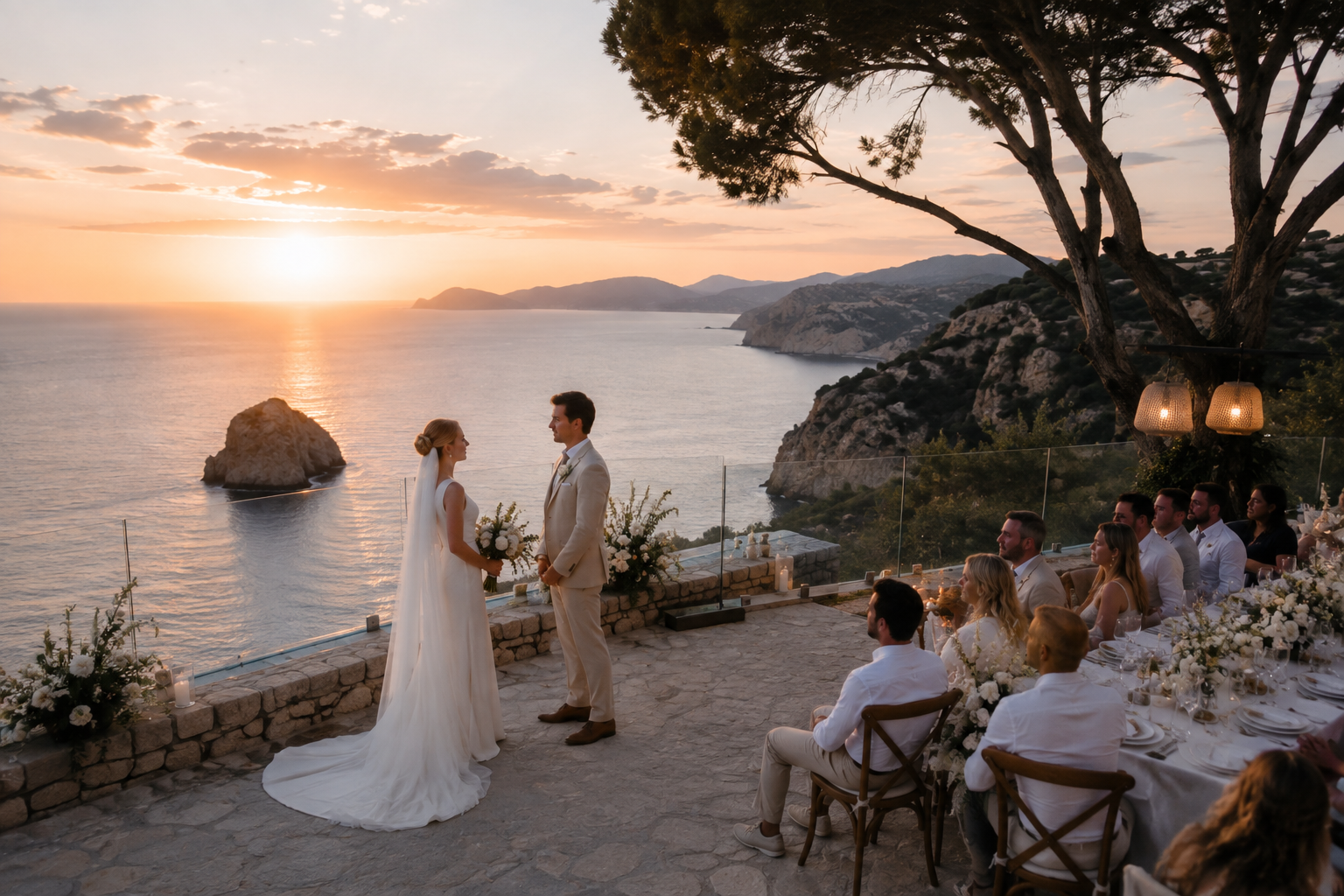
A full gallery tells you whether a photographer can handle:
- getting ready;
- strong daylight;
- ceremony;
- family groups;
- emotional candids;
- sunset portraits;
- speeches;
- dark reception spaces;
- dance floors.
At Revvind, our approach combines documentary photography with gentle direction when it is useful. Most of the wedding is allowed to happen naturally. When the light becomes special or you need help with portraits, we step in.
You can explore our full wedding photography and film approach on the Weddings page.
Do You Need a Wedding Videographer Too?
Photography and video remember different things.
A photograph preserves the exact expression on someone's face. Film preserves the way their voice sounded, the pause before the vows, the movement of a dress in the wind, the applause after the ceremony and whatever happened on the dance floor at midnight.
For a destination wedding, video can be particularly powerful because the place itself becomes part of the memory: waves, cicadas, church bells, Spanish guitar, glasses touching during a sunset toast.
If you want both, booking a photo and video team accustomed to working together can make the coverage feel less intrusive and reduce competition for the same angles.
See our Videography options if film is part of your plans.
Welcome Dinner: Worth Adding?
For destination weddings, yes — very often.
The welcome evening solves two problems at once.
First, guests arriving from different countries get a chance to meet before the wedding. By the next day, the room already feels warmer.
Second, it creates a completely different visual chapter in your wedding story.
A welcome event can be:
- relaxed tapas in Palma;
- a finca dinner;
- rooftop cocktails;
- beach club drinks;
- a sunset boat trip;
- private villa barbecue.
It doesn't need the same production level as the wedding. In fact, it is usually better when it doesn't.
From a photography perspective, the welcome event gives us a chance to meet families and friends before the wedding day, which often makes everyone more comfortable around the camera later.
What About a Day-After Session?
A day-after shoot is one of the easiest ways to remove pressure from the wedding timeline.
Instead of travelling to a dramatic cliff, beach or village during the wedding, we keep wedding-day portraits close to the venue and photograph the adventurous session the following evening.
This works particularly well when:
- your dream portrait location is far from your venue;
- you want sunset beach photographs;
- the wedding outfit deserves more than twenty minutes;
- you want cinematic video around Mallorca;
- spending time with guests matters more than leaving cocktail hour.
It can also become part of the honeymoon rather than another wedding obligation.
A Sample Three-Day Mallorca Destination Wedding
Day One — Welcome
Afternoon: guest arrivals and hotel check-in.
Evening: relaxed welcome dinner or cocktails.
Keep speeches minimal. The purpose is to get everybody comfortable and excited, not to start the formal wedding twenty-four hours early.
Day Two — Wedding
Late morning / early afternoon: slow preparation.
Afternoon: getting-ready photography and first look if planned.
Late afternoon: ceremony.
After ceremony: congratulations, family photographs and cocktail hour.
Golden hour: short couple portrait session.
Evening: dinner and speeches.
Night: first dance and party.
The exact times should be based on your season, venue and sunset rather than copied from somebody else's wedding.
Day Three — Recovery
Brunch, pool party, beach club or boat day.
For couples still full of energy, this is also an excellent window for a relaxed day-after portrait or video session.
Mallorca Wedding Planning Checklist
12+ months before
- choose approximate guest count;
- decide legal vs symbolic ceremony;
- shortlist season;
- begin venue search;
- contact planner;
- shortlist photographer and videographer.
9–12 months before
- secure venue;
- book core creative vendors;
- send save-the-dates;
- reserve major guest accommodation blocks;
- start transport planning.
6–9 months before
- styling and flowers;
- entertainment;
- menu planning;
- ceremony structure;
- welcome-event concept.
3–6 months before
- build preliminary wedding timeline;
- discuss lighting with photographer;
- confirm guest transport;
- review ceremony logistics;
- plan family-photo groups.
Final month
- final guest numbers;
- complete seating;
- vendor timeline;
- weather backup;
- transport confirmation;
- sunset and portrait windows;
- emergency contacts;
- legal documents if applicable.
Mistakes We Would Avoid
Trying to see too much of Mallorca on the wedding day
You chose Mallorca, but you do not need photographs in five different parts of Mallorca.
A cohesive venue with ten minutes of excellent light will usually give you stronger memories than a two-hour island tour in formal clothes.
Planning an outdoor ceremony only for the view
Look at where the sun will be, where guests will sit and whether shade exists.
Making every minute productive
A destination wedding needs empty space in the schedule.
That “unused” 20 minutes may become the moment you actually get to speak to your parents, have a drink together or realise that you just got married.
Forgetting transport home
Getting guests to the wedding is only half the problem. Decide how people leave at midnight, 1 AM and 3 AM.
Treating photography as something to fit in later
If photographs matter, involve your photographer before the timeline becomes fixed.
Our Approach to Mallorca Destination Weddings
At Revvind, we don't want a wedding day to feel like a photoshoot with dinner in the middle.
We start with the wedding you actually want: your people, your ceremony, your venue, your priorities. Then we find the best light inside that plan.
Sometimes that means ten minutes outside during dinner because the sky suddenly becomes incredible. Sometimes it means abandoning the original portrait location because the wind has other ideas. Sometimes it means putting the cameras down for a moment because what you need is to breathe rather than pose.
Local experience helps us know when to direct and when not to interfere.
If you're planning a destination wedding in Mallorca, Spain, you can see our photography and videography work and check availability on our Mallorca Weddings page.
FAQ
Can foreigners legally get married in Mallorca?
Foreign nationals can marry in Spain under Spanish rules or, in certain circumstances, according to the personal law of either foreign party. A legally valid Spanish marriage requires the relevant prior marriage procedure or authorisation. The documents and practical process depend on your circumstances, so confirm requirements directly with the relevant Civil Registry, municipality or Spanish consular authority well before the wedding.
Is it easier to have a symbolic wedding in Mallorca?
For many international couples, completing the legal marriage at home and holding a symbolic ceremony in Mallorca is administratively simpler. It lets the Mallorca celebration focus on the ceremony and guests without depending on international marriage paperwork.
How far in advance should we start Mallorca wedding planning?
For a destination wedding, we recommend beginning major planning roughly 12–18 months ahead when possible, particularly if you want a specific venue or popular-season weekend. Smaller or off-season weddings can often be organised in less time.
What are the best months for a Mallorca destination wedding?
There is no universal best month. From a wedding-photography and guest-comfort perspective, we particularly like May, June, September and early October, while July and August suit couples who specifically want peak-summer Mallorca and are happy to structure the day around heat and later evening light. Historical climate information for the Balearics is available from Spain's AEMET.
Do we need a wedding planner in Mallorca?
It isn't legally required, but a local planner can be extremely useful for a destination wedding involving multiple suppliers, guest transport, venue logistics and events spread over several days.
Should we provide transportation for our guests?
For remote fincas, mountain venues and some coastal locations, we strongly recommend organised transport. It reduces late arrivals, parking problems and concerns about guests driving after the reception.
How long should we leave for wedding photographs?
There is no need to disappear for hours. With good planning, we often divide portraits into shorter sessions: a brief window after the ceremony and another 15–25 minutes in the best evening light.
Is golden hour really that important for Mallorca wedding photography?
It is not the only good light, but it is often the easiest time to create soft, warm outdoor portraits with less squinting and gentler shadows. A good photographer should still be able to work throughout the day rather than relying exclusively on sunset.
Should we book photography and videography together?
You do not have to, but a team that regularly works together can coordinate angles, audio, lighting and timelines more efficiently. It is particularly useful when you want documentary coverage without having several separate crews surrounding you.
Is a welcome dinner worth it?
For destination weddings, we think it often is. It helps guests meet before the ceremony and gives the wedding weekend a more relaxed beginning. It can be much simpler than the main celebration.
Should we have a day-after photoshoot?
Consider it if your dream photo location is far from the wedding venue or if you would rather spend cocktail hour with your guests. A day-after session gives you freedom to chase a beach, village or mountain sunset without compromising the wedding timeline.
How do we choose a Mallorca wedding photographer?
Look beyond individual portfolio images. Ask to see complete wedding galleries, check experience with Mallorca light and logistics, understand delivery and backup procedures, and choose somebody you are comfortable spending an emotionally intense day around.
Plan Well, Then Let the Day Happen
A Mallorca wedding can be elegant, wild, intimate, traditional or completely unconventional. What makes it work is not trying to include everything the island offers, but choosing the parts that actually belong to your story.
Plan the legal side early. Give your guests a simple experience. Build the day around how you want it to feel, not just how it looks on a spreadsheet. Leave breathing room. Protect the best light without sacrificing the celebration.
And once the wedding starts, stop planning it.
That's when the good part begins.
Planning your own Mallorca destination wedding? Explore Wedding Photography & Videography by Revvind and tell us what you're imagining.